 viajeseci.es


Date
Friday, 6 Nov. 2026
General timing
From 9:00 to 13:30 approximately
Technical tour 01
Port of Málaga
Port pavements, East Breakwater seawall strengthening and rapid-repair demonstration
A technical tour combining three real heavy-duty infrastructure settings: the rehabilitation of the seawall of the East Breakwater (Dique de Levante), operations at the multipurpose terminal on Quay 9, and a live concrete pavement slab repair demonstration using Peragrene technology.
East Breakwater
Seawall · Phase III strengthening
Quay 9 · Noatum
Multipurpose terminal · 385,081 m²
Peragrene demo
Real repair of 1 slab · ≈5 m³
What you will see
East Breakwater seawall
The tour will present the structural strengthening works on the seawall. The rehabilitation programme aims to restore structural performance, safety and durability under marine exposure and storm action. Phase III was tendered with a €2.95 million budget and a six-month execution period.
Quay 9 multipurpose terminal · Noatum
A real operating environment for pavements subjected to severe port loading. The terminal covers 385,081 m², provides 723 m of berth line and includes a 103,663 m² container area, together with ro-ro and bulk-handling areas.
Peragrene live demonstration
A real pavement slab repair is planned. Demolition and site preparation will be completed in advance; during the tour, participants will see on-site production, placement and finishing of high-early-strength concrete intended to reduce asset downtime.
Technical focus
Technical tour 02
Málaga Metro
Slab track in an urban metro system
The Málaga Metro visit is focused on railway infrastructure and, in particular, slab track: a solution in which conventional ballast is replaced by a rigid concrete support structure, especially suited to underground sections and environments where maintenance access is constrained.
Network
2 lines
Length
13.6 km
Stations
19 · 14 underground
The network
Málaga Metro is a standard-gauge (1,435 mm) light metro system. It opened in 2014 and reached the city centre, at Atarazanas, in March 2023. The operating network has 18 trains and a maximum speed of 70 km/h.
Key features of the visit
Rigid concrete support
Underground sections use slab track. Technical documentation for the network extension specifies an Edilon Embedded Block System (EBS) LR 54E1 type system or equivalent.
Track geometry and maintenance
By removing ballast, track geometry is fixed to a rigid, stable support. The solution reduces periodic tamping operations and is particularly relevant in tunnels, where maintenance access is more restrictive.
Technical tour 03
Urban pavement + Mayoral Logistics Centre
From public-space concrete to a high-performance industrial floor
This route will combine an urban concrete pavement —location still to be confirmed— with the rehabilitation of the former Intelhorce finishing hall, now the Mayoral Logistics Centre. The common theme is concrete as a durable solution in both public space and a large industrial pavement.
1st stop
Urban pavement · TBC
2nd stop
Mayoral Logistics Centre
First stop · Urban concrete pavement
The final location will be added once confirmed. The visit will focus on how concrete pavement is integrated into the urban environment: surface texture and finish, joints, edge details, accessibility, drainage, performance under service traffic and maintenance/retexturing strategies.
Second stop · Mayoral Logistics Centre
Adaptive reuse of industrial heritage
The former Intelhorce finishing hall, built in 1963 by Vázquez Molezún and Valdés, was rehabilitated while retaining its major concrete structure. The building exceeds 20,000 m² and preserves the spatial character of Málaga’s former “industrial cathedral”.
Rehabilitated concrete structure
The project restored reinforced-concrete elements with more than half a century of service and adapted the building envelope to its new logistics use. The structure is characterised by large Y-shaped columns, double beams and a distinctive precast-concrete roof.
New industrial concrete floor
The interior incorporates a shrinkage-compensated concrete floor designed to improve dimensional stability and reduce the number of joints. Construction used laser screeds and dedicated flatness/levelness control, critical parameters for a logistics platform.
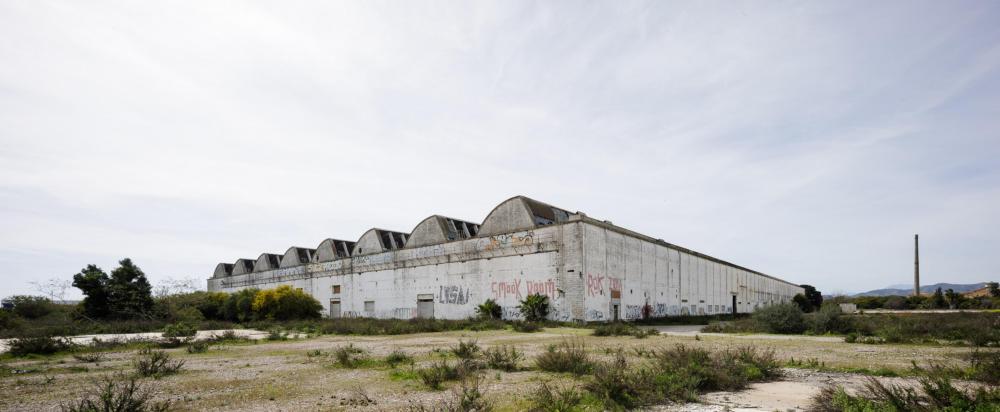
Before rehabilitation
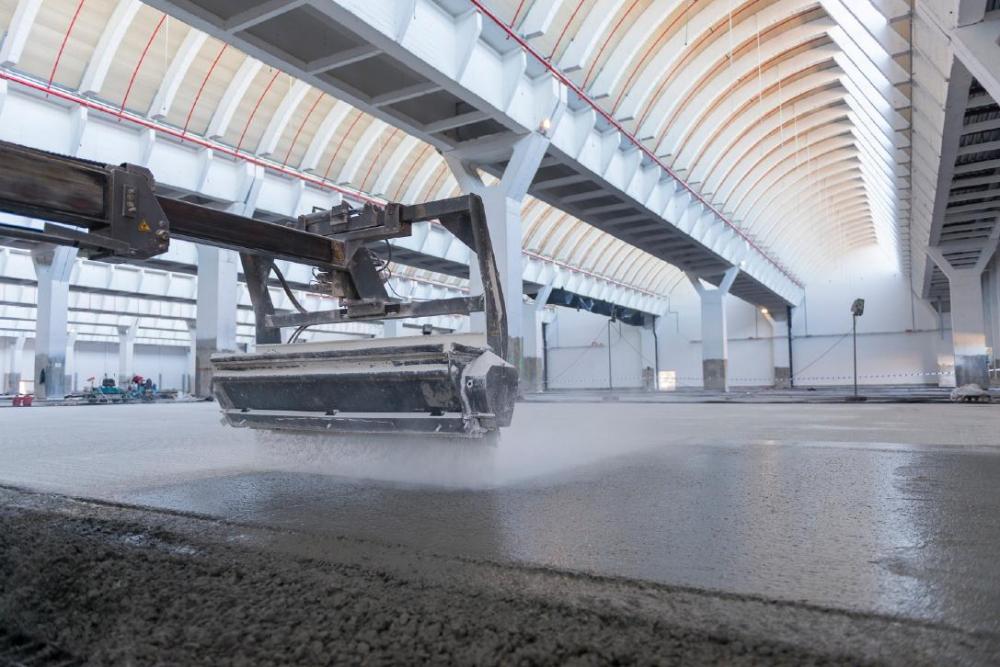
Floor construction
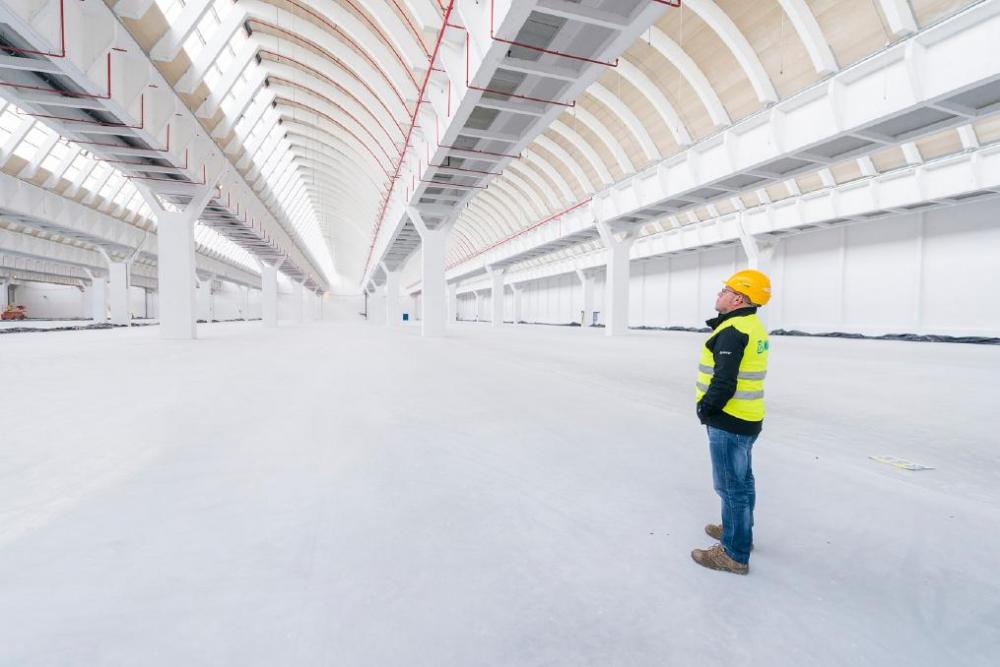
Completed floor
Institutional Support
Supporting Organizations
Australian Society for Concrete Pavements
Asociación Española de Pavimentos Continuos
World Road Association
Asociación Nacional de la Industria del Prefabricado de Hormigón
International Society for Concrete Pavements
Plataforma Tecnológica Española del Hormigón (PTEH)
Plataforma Tecnológica Fotocatálisis (PTF)
TECHNICAL SECRETARIAT